Provisions

Definition: Provisions refer to the practice of retaining an estimated fund out of the profit by the firm so as to cover an uncertain anticipated loss or to reduce the value of the asset in the future. It is a liability whose time of occurrence and the amount is not known. Liability here means liability for expenses. The funds are set aside for a particular purpose only and it must be used for the same.

As per the matching concept of accounting, the expenses and revenues of business need to be recognized in the same financial year in which they arise, to make the financial statements more accurate. The provisions form part of both, Balance Sheet as well as the Income Statement. Provision for Doubtful Debts, Provision for Depreciation, Provision for Discount on Debtors, etc. are examples of Provision.

Now the question arises – When the provision is recognized?

Well, a provision is recognized when:

  • A present obligation arises from a past event
  • There is a possibility that to settle the obligation, the outflow of resources representing economic benefits will be needed.
  • A reliable estimation of the amount of the liability can be made.

Note: It must be noted that provision can be used for those expenditures only for which it was originally recognized or created by the firm.

Characteristics of Provisions

As per the Convention of Conservatism, provisions must be created for all identifiable liabilities, expenses, and losses. Also, probable losses occurring due to contingencies need to be provided for. It is characterized by:

  • Provision is a charge against profit
  • It is not an asset, rather it will reduce the net assets of the firm.
  • It is provided for an expected contingency, that may arise in the future like Liability for a disputed claim.
  • Follows matching convention, i.e. all the actual and estimated current year’s losses need to be adjusted against the current year’s revenues or profits.
  • The value of provision cannot be ascertained with significant accuracy.
  • Reflects true current year’s profit.
  • It is provided to meet known losses or outstanding liability

It must be noted that if a provision is made in excess of the amount which the directors think is reasonably necessary for the purpose, the excess amount should be treated as a reserve and not as a provision.

Classification of Provisions

Provisions are broadly classified into two categories:

On the basis of Assets and Liabilities

  • Based on assets:
    1. Depreciation of Assets
    2. Renewal of Assets
    3. Reduction in the value of Assets
  • Based on Liabilities
    1. Expected Contingencies
    2. Outstanding Liabilities

On the basis of Objectives

  • General
  • Specific

Accounting Treatment of Provisions

Provisions are a charge against profit. And so to create the profit and loss account is debited for a specific and known contingency or any expected loss. For this purpose a definite sum is charged every year out of the current year’s profit, to meet the contingency or loss. Therefore, it is posted on the debit side of the Profit and Loss Account. Additionally, these are shown at the asset side of the Balance Sheet, by reducing the amount of provision from the amount of the concerned asset.

For example Provision for Discount on Debtors and Provision for Doubtful Debts appear as a deduction from debtors. Similarly, Provision for Depreciation appears as a deduction from Plant and Machinery.

However, it can also be shown on the liabilities side like provision for taxation or provision for creditors.

Needs of Provision

Provision is created for:

  • Depreciation, renewal, or diminution in the asset’s value
  • Disputed claim
  • Writing off bad or doubtful debts
  • Specific loss on realization of an asset or on tax payment
  • Contingent liabilities
  • Known liability whose amount cannot be ascertained with substantial accuracy.
  • Redeeming liability

Rules for Creation of Provisions

There are certain rules for the creation of provisions, which must be followed strictly, these are:

  • It can be provided by debiting the profit and loss account.
  • The provisions are made to cover the loss arising due to the known liability or any contingency.
  • Provisions are not associated with profits, as they can be created without referring to the profitability position of the company. Meaning that it can be created even when the company has incurred a loss in a particular financial year.
  • The amount set aside for provision, cannot be distributed as dividends among shareholders.
  • For the creation of provision, a fixed sum is retained every year to cover the contingency.
  • To meet the expected contingency or anticipated liability, the creation of a provision is necessary.
  • It appears on the liabilities side of the balance sheet.

Reserves

Definition: Reserve, as the name suggests is a part of undistributed profit retained in the business so as to provide for specific future needs like growth and expansion, or to meet any known or unknown expenditure or contingency, liability, or reduce the value of the asset. This means that profit is kept in the business and not distributed otherwise, which helps in future expansion activities.

It is an appropriation of profit that strengthens the company’s financial position. Therefore, it decreases the amount of profit that is available for distribution, among the company’s shareholders. It appears on the liabilities side of the Balance Sheet, under the head Reserves and Surplus.

Salient Features of Reserves

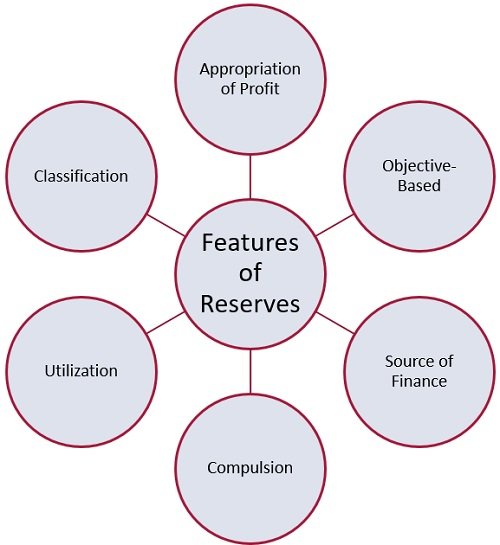
Reserves are that portion of the profit that is earmarked for a specific purpose. The salient features of Reserves are:

  • Appropriation of Profit: Reserves constitute the earned income of the firm. Hence, reserves can be created only when the firm has earned profits. Therefore, in the financial year in which the firm has suffered losses, the reserves are not created.
  • Objective-Based: The creation of reserves is for unknown liability and not for known liability.
  • Source of Finance: Reserves are among one the internal sources of finance. Hence, it can be used as capital instead of distributing as a dividend to the shareholders.
  • Compulsion: The creation of reserves is not required by the statute. Nevertheless, as per Transfer of Reserve Rules, companies are required to create a certain amount of reserves out of profit, prior to the distribution of dividends.
  • Utilization: Utilization of reserves are restricted to specific areas only, which are prescribed under various sections of the Companies Act, and also in the Accounting Standards.
  • Classification: The classification of reserves is based on the purpose, for which the reserves are created. However, they are also created even when the purpose for their creation is not known

Classification of Reserves

The reserves are classified into two categories based on the creation and based on the objective:

Based on Creation there are two types of reserves:

Revenue Reserve

Revenue Reserves are the reserves that are created out of profit earned by the firm during the day-to-day business operations. Profit withheld from paying dividends out of the total distributable profit is called Revenue Reserve

Examples of Revenue Reserve

  • General Reserve
  • Debenture Redemption Reserve
  • Retained Earnings
  • Dividend Equalization Reserve

Capital Reserve

The reserves which are created out of the capital profit generated from the following:

  • Sale of fixed assets
  • Settlement of liabilities
  • Premium on issue of shares
  • Pre-incorporation profit

Such reserves are called capital reserves. It is a device for conserving profits and adds stability to the company’s finance. It does not include any free balance that can be used for the purpose of distribution of profit.

Examples of Capital Reserve

  • Issue of shares at a premium
  • Profit accruing on sale of fixed assets.
  • Profit prior to incorporation
  • Profit on redemption of debenture
  • Premium on issue of shares and debentures
  • Balance of forfeited shares account
  • Creation of capital redemption reserve after preference shares are redeemed.
  • Profit arising from the revaluation of fixed assets after considering all restrictions.

Based on Objectives there are three types of reserves:

General Reserve

Free reserves which are not created for a specific objective and are meant to meet unforeseen future uncertainties, liabilities or commitments, are called general reserve. It is a source of internal finance. The reason for its creation is to improve the company’s financial status, to arrange funds for meeting abnormal losses, to provide means for further expansion of operations.

It means ploughing back of profits and is not binding upon the companies to maintain a general reserve. Hence, it can be created if the management thinks fit and the profits are sufficient.

Example of General Reserve

  • Reserve fund
  • Contingency Reserve

Specific Reserve

Specific Reserve is the one created for a definite purpose such as:

  • For equalizing the rate of dividend: Dividend Equalization Reserve is created.
  • For acquiring assets: Building Reserve and Machinery Reserve are created.
  • For developing business: Development Reserve is created.
  • For redemption of liability: Capital Redemption Reserve and Debenture Redemption Reserve is created.
  • For covering the variation in the price of investments: Investment Fluctuation Reserve is created.

Statutory Reserve

The reserve which is made due to the requirement of the law of land is termed as a statutory reserve, such as capital redemption reserve, whose creation is mandatory.

What is Secret Reserve?

Reserves that are not shown in the balance sheet are termed as a secret reserve or hidden reserve. If the secret reserve is created, then it is quite obvious that the true and fair picture of the financial position is not depicted by the financial statements of the company.

Secret reserve is created to meet extraordinary losses in the future, to strengthen the company’s financial position, to show a steady trend of profit earning, to evade taxes, etc.

The firm can use the given means to create secret reserve:

  • Charging of capital expenditure as revenue expenditure.
  • Providing for more depreciation on fixed assets.
  • Creation of excessive provision for bad and doubtful debts.
  • Suppression of sales
  • Indicating imaginary liabilities or overvaluation of liabilities
  • Indicating contingent liabilities as real liabilities
  • Undervaluation of stock in trade
  • Omission of a few assets from the balance sheet.
  • Inflating purchases

Accounting Treatment of Reserves

Reserves are created by debiting the profit and loss appropriation account. A profit and loss appropriation account is created along with the profit and loss account which reveals the distribution of profit among reserves, funds, and dividends. And to do so journal entry is passed wherein profit and loss appropriation account is debited and the respective fund or reserve account is credited.

Double Entry System

Definition: Double Entry System refers to the system of bookkeeping that is prevalent at present. According to this system, every transaction has equal and opposite effects, in a minimum number of two accounts.

For Example:

Suppose a firm purchased a laptop for cash Rs. 70,000. The two aspects of this transaction are that the amount of cash is reduced and assets, i.e. laptop comes into the organization.

Hence, in the double-entry system, both aspects of the transaction are entered into the financial books. It is also termed a complete entry system.

As in physics, every action has an equal and opposite reaction. Similarly, in the field of accounting, every transaction results in an equal yet opposite balance in accounts, i.e. debit and credit.

Therefore, the transactions are entered in the financial books as regards debit and credit, wherein debit in a particular account is counterbalanced by the credit in another account. It requires that for different transactions that have occurred during the course of business, the amount entered in the debit, of a particular account must tally with the amount entered in the credit of the corresponding account.

The system was developed by an Italian Mathematician Luca Pacioli, in the year 1494.

Each transaction has two aspects, wherein one receives the benefit while another gives away the benefit. And to keep a systematic record of the transactions, both aspects must be recorded. And the account that receives the benefit is debited whereas the account that foregoes the benefit is credited.

The system is based on the assumption that there won’t be any giving without receiving. Hence, for every debit, there is a corresponding credit. Based on the Double Entry System, the accounting equation can be expressed as:

Owner’s Equity + Outsider’s Equity = Total Assets

Or

Capital + Liabilities = Total Assets

Characteristics of Double Entry System

Double Entry System is characterized by:

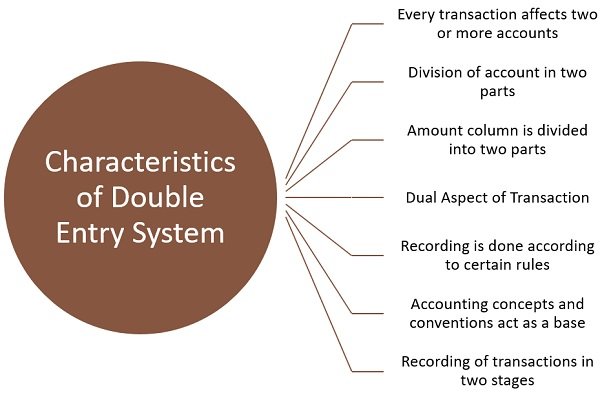
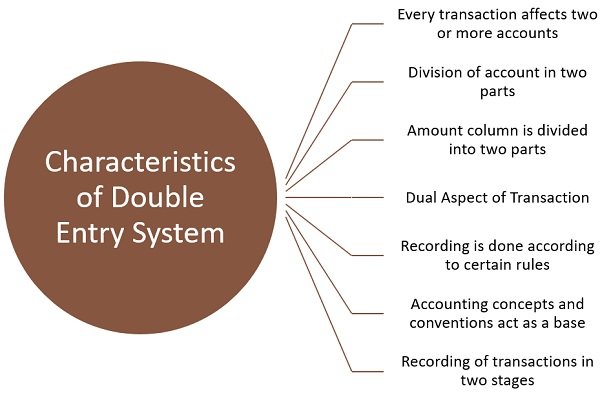
Every transaction affects two or more accounts: In every business transaction two accounts are involved, wherein one is debited while the other is credited. When one transaction affects multiple accounts, the amount of the accounts which are debited and credited are always equal.

Division of account in two parts: The basis of preparation of ledger accounts are journal and subsidiary books. Each of them has two sides wherein the left side is debit and the right-hand side is credit.

Amount column is divided into two parts: There is a division of the amount column into debit and credit.

Dual Aspect of Transaction: It is based on the notion that every debit has an equivalent credit. That is why they are recorded simultaneously on the debit and credit sides.

Recording is done according to certain rules: There are golden rules of accounting on the basis of which the recording of transactions is made in the books of accounts. These are basically rules for debit and credit.

Accounting concepts and conventions act as a base: Double Entry System of bookkeeping relies on the universally accepted conventions and concepts, which are required to be followed while maintaining accounting books.

Recording of transactions in two stages: It enables the recording of transactions at two stages – initially in a detailed manner and then in a summarized manner, which brings correctness of recording and generating accounting information.

Advantages of Double Entry System

  • It keeps a complete record of every transaction and classifies them as assets, liabilities, expenses, revenue, capital, etc.
  • A systematic record of the business transaction is maintained which provides relevant information in just one glance.
  • It facilitates proper scrutiny and verification of the records, based on documentary proofs and vouchers.
  • Preparation of final accounts helps in ascertaining the profit or loss for the accounting year, as well as the company’s position of assets and liabilities.
  • Comparison between current years’ financial statements with those of the previous year, as well as actual and desired performance can also be compared. Also, the financial statements of the two companies can be compared.
  • A systematic record of business transactions based on a double-entry system helps in the identification of fraud, errors, and embezzlement.

Disadvantages of Double Entry System

  • Due to the two-fold recording of every transaction, the overall work of bookkeeping increases.
  • It is a bit costly to keep detailed accounts.
  • It requires the maintenance of a number of books which becomes cumbersome.
  • A person with good knowledge and experience in accounting can prepare and maintain accounts.

Sinking Fund

Definition: Sinking fund refers to a specific reserve fund, in which money is earmarked and accumulated over time, for the purpose of redemption of debt, bond, and also for the replacement of a wasting asset. It is obligatory to invest these funds outside the business because when the maturity of the underlying debt becomes due, funds can be availed easily by selling the investment, and no effect is shown on the company’s working capital.

Sinking Fund
Definition: Sinking fund refers to a specific reserve fund, in which money is earmarked and accumulated over time, for the purpose of redemption of debt, bond, and also for the replacement of a wasting asset. It is obligatory to invest these funds outside the business because when the maturity of the underlying debt becomes due, funds can be availed easily by selling the investment, and no effect is shown on the company’s working capital.

While making an investment into securities, three things are basically considered:

  • Safety of funds
  • Regularity of Income
  • Liquidity of Funds

The amount of installment which is invested is calculated using Annuity Table.

It aims is to make available the ready cash for the repayment of liability. Further, how much money is to be invested is dependent on the following factors:

  • Amount needed at the time of maturity.
  • Period of maturity
  • Interest rate

It is usually advisable to invest such funds in government securities (guilt-edged securities), carrying a fixed interest rate. Interest earned thereon is further invested in securities. The objective of this investment is that when the debt gets matured or the life of the asset expires, investments are sold and the proceeds are used to repay the debt or replace the asset.

It is an accumulation of earnings, in which an amount is added either as a fixed percentage of outstanding debt or a fixed percentage of profit. The term ‘sinking‘ is used to mean the dropping level of debt, left out as it gets paid off, whereas the term ‘fund‘ represents the amount invested in outside securities.

Companies that raise money by issuing debt instruments like debentures or bonds, need to pay off the debt or buy back the issued instruments when the maturity date is reached. With the help of a sinking fund, the large outflow of funds can be managed easily. Hence, a sinking fund is created so that the company can contribute to the fund every year and use them at the time of need.

Types of Sinking Fund

Based on the treatment of interest

  • Cumulative Sinking Fund: Sinking Fund maintained on a cumulative basis is called a cumulative sinking fund. A fixed amount is set aside every year from profits and then they are invested in securities and interest received on such investments is invested again.
  • Non-Cumulative Sinking Fund: In this type of fund, the interest on the investment does not accumulate in the fund, i.e. there is no reinvestment of securities and only installments are invested.

Based on Usage

  • Sinking fund to replace fixed asset: Till the loan is repaid, the amount is an appropriation of profit and so the profit and loss appropriation account is debited. On the repayment of liability, the balance available in the sinking fund account is taken to the general reserve.
  • Sinking fund to repay long-term liability: The fund is a charge against profit in the form of depreciation and the profit and loss account is debited. On the replacement of an asset with a new machine, the balance available in the sinking fund account is taken to the old asset account, so as to write off the asset.

Accounting Treatment of Sinking Fund

The Sinking Fund account appears on the liabilities side of the balance sheet, whereas the amount invested in securities is displayed on the asset side of the balance sheet. Sinking fund investment is the replacement of liquid assets, and sinking fund is the replacement of profit.
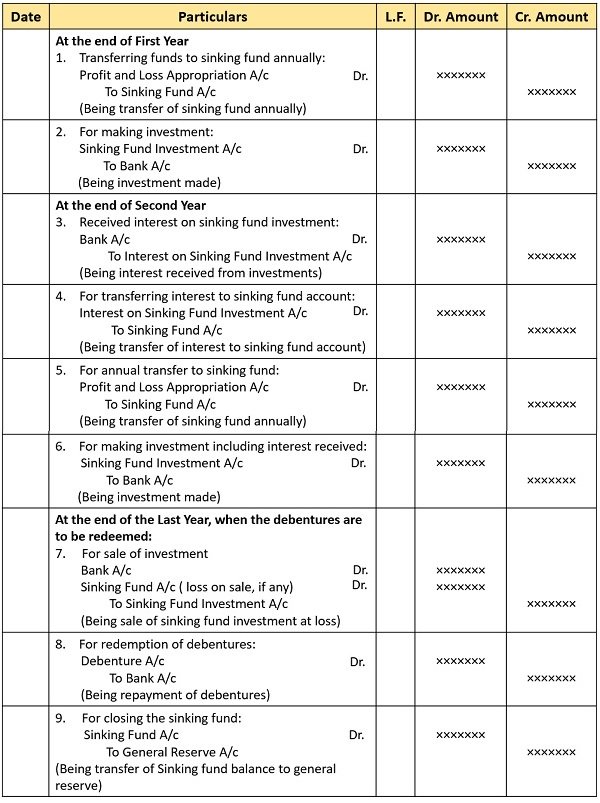
It is to be noted that after the issue is made, the annual contribution to the fund consists of a profit and loss appropriation account and the total amount is invested in marketable securities, at the end of the first year. Further, at the end of the second year, interest is received at a certain rate on the investments made.

So, the annual contribution along with the interest received is reinvested in securities and the process continues year by year. In the last year, the interest and the annual contribution is earmarked towards the sinking fund and all the existing investments are sold, for cash.

Further, if there is any loss or profit on the sale of investments that will be debited and credited to the fund. In this way, the sale of investments enables the redemption of debentures. And once the debentures are redeemed, the sinking fund is of no use. Hence, the fund is closed and the remaining balance is taken to general reserve.

Journal Entries for Sinking Fund

The journal entries for the sinking fund are as under:

Discount

Definition: Discount implies a concession or deduction allowed at a specified rate from the price of the goods given by the seller to the buyer or by the creditor to the debtor. It is given to lure customers and promote sales. The amount of discount must be received or paid with regard to the terms of the sales agreement. Here, it is to be noted that discount is always calculated on the marked price of the item.

On the application of the discount, the receiver of the sum gets a reduced amount than the sum actually due to be paid. Conversely, the payer of the sum has to pay a smaller sum than was actually due for payment. That is to say, a discount results in a loss to the receiver, but profit to the person who has to pay.

Types of Discount

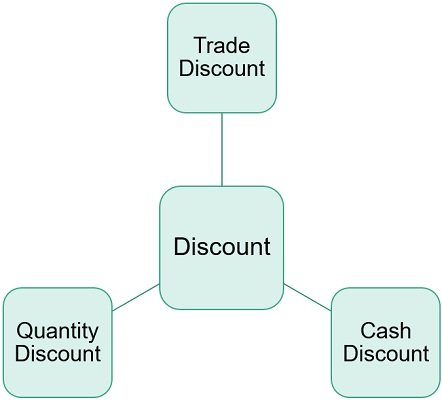
There are three main types of discount, discussed hereunder:

Trade Discount

A deduction from the given list price is regarded as a trade discount. It is provided by the manufacturer or wholesaler to the retailer, on the retail price of the product. It indicates the profit margins of the reseller, as the reseller sells the product to the final consumer at retail price. Further, they are subtracted as a part of the initial sale, they are not sales discounts.

This is provided to increase the sales volume. Further, it is given as a percentage of the listed price. Once this discount is given, the net sale price or net amount which the customer has to pay will be calculated. Further, no recording of such discount is made in the books of accounts. That is to say, transactions are recorded at their net sales value.

For example, the list price of a Bluetooth speaker is Rs. 4000 on which the wholesaler allowed a 10% trade discount to the retailer. So, the retailer will get the speakers at Rs. 3600.

Cash Discount

In this, the deduction from the price is made when a cash payment is made. This is provided to the customers to increase prompt payment and flow of cash. It is provided to the customer when he makes payment on time before the due date. Calculation of this type of discount is given as a percentage based on the total amount payable.

Credit terms printed on the sales invoice generally include: Goods billed are subject to cash discount @ (percentage), if paid within ten days, else full amount will be charged.

For Example: Considering the above example, if the retailer is eligible for a cash discount of 5% for making prompt payment, then first of all trade discount will be deducted, thereafter a cash discount will be calculated on the net price, i.e. 3600. So the cash discount will be Rs. 180 and the net payment will be 3600 – 180 = 3420.

Quantity Discount

Another name for quantity discount is a volume-based discount. A discount provided to the customer from the list or catalog price, for making purchases in bulk, it is called quantity discount. It is given to encourage the purchase of goods in bulk. So, the recording of purchase is done at the net purchase price. Plus, no separate account is created to record quantity or volume-based discounts.

Calculation of discount

To calculate the cost of the article after discount, when the discount is given as a rate on the listed price, you need to write the percent as a fraction and multiply it with the price. The result obtained will be subtracted from the original price of the goods.

What is Successive Discount

Series of discounts offered to the customers are called successive discounts. In case when successive discounts are given, the first discount is deducted from the marked price, to arrive at the net price after giving the first discount.

The price calculated is considered as the new marked price, and then the second discount is calculated on the new marked price, then the resultant sum is subtracted from the new marked price to get the net price after the second discount. This process is continued to reach the net selling price.

Buy Back of Shares

Definition: Buy Back of Shares, or Share Repurchase is a corporate move wherein a company purchases its own outstanding shares from the current shareholders. This buyback takes place at a higher price than the actual market price. Further, the motive behind this is to reduce the number of shares present in the open market.

When the company repurchases shares, cancellation of such shares is a must. Buyback of shares for the purpose of investment is not permissible.

With buyback, the outstanding shares on the market decrease. Therefore, it results in an increase in the proportion of shares that the company owns. So, the ownership stake of the existing shareholder’s increases. Also, there is a decrease in the company’s share capital.

Modes of Buy Back

  • Tender Offer: Presentation of a tender offer to shareholders by which they get the alternative to submit either a portion or all of their shares within the given time frame. This alternative is available at a premium to the existing market price. Further, the premium is to compensate the investors for tendering (submitting) shares instead of keeping them.
  • From the Open Market: The company repurchases shares on the open market over a long time span. It is possible through the book-building process or stock exchange.
  • From Odd lot holders
  • By purchasing securities issued to employees under ESOP (Employee Stock Option) and Sweat Equity Shares.

Sources of Buy Back

Buying of own shares and other specified securities out of:

  • Free reserves of the company, e.g. general reserve, reserve fund, credit balance of Statement of Profit and Loss Account or
  • Securities Premium Account or
  • Proceeds of the issue of any shares or other specified securities.

Note: Buyback of shares or any other specified securities cannot be made out of the proceeds of previous issues of the same kind.

Reasons for Buy Back

The company initiates the buyback of shares because of the following reasons:

  • Improving earnings per share
  • Improving return on capital, and return on net worth.
  • Offering an additional exit route to the shareholders if the shares are undervalued or not actively traded in the share market.
  • Preventing unrequested takeover bids.
  • Returning excess cash to shareholders.
  • Attaining optimum capital structure.
  • Increasing the market value of remaining shares in the market as there will be a reduction in supply. This automatically increases the demand for the company’s shares.
  • Preventing other shareholders from owning the controlling stake in the company.

Calculation of Maximum Number of Shares that can be Bought Back

Conditions of Buy Back

  • Authorization by Articles: The articles of association (AOA) of the company permits it to do so.
  • Resolution: The company passes a special resolution on this, in the general meeting.
  • Fully paid up shares: Shares of the company are fully paid up.
  • Percentage: The buyback should not be more than 25% of the total paid-up capital and free reserves of the company.
  • Debt-Equity Ratio after buy-back: Post-buy-back, the ratio of debt that the company owes should not exceed twice the capital and free reserves. In short, the debt-equity ratio after the buyback should not be more than 2:1. Nevertheless, the central government can determine a higher limit in specific cases.
  • Time Limit: Within 12 months from the date of passing the special resolution at AGM, the buyback should be complete.
  • SEBI Regulations: Buy Back of shares are listed on any recognized stock exchange. Further, it should be as per the regulations made by the Securities Exchange Board, in this context.
  • Destroy: The shares or securities bought under this process need to be destroyed physically. This must take place within seven days from the last date of completion of buyback.
  • Restriction on the further issue: Company cannot make a further issue of the same kind of shares or securities within 6 months. However, it can issue:
    Bonus shares
    Sweat equity shares
    Under ESOP
    In place of conversion of warrants or preference shares or debentures into equity shares.
  • Buy Back not Allowed when: Company cannot purchase its own shares or other specified securities directly or indirectly by way of:

1. Any subsidiary company (including the company’s own subsidiary)
2. Any investment company or its group
3. Or any company which has failed to pay interest, deposit, dividend, term loan, redemption amount of preference shares or debentures and so forth, is subsisting.

  • Explanatory statement: Notice of General Meeting which company issues must include an ‘Explanatory Statement’ containing:
    1. Complete disclosure of material facts
    2. Need for buyback of shares
    3. Class of securities which the company intends to buy back
    4. The amount which the company will invest under this process and
    5. The time limit for its completion

Note: The company shall pass a board resolution when the shares are repurchased up to 10% of the total equity share capital and free reserves.

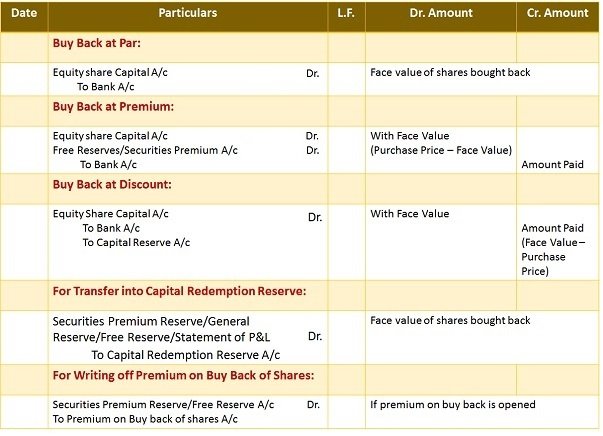
Journal Entries for Share Buy Back

Points to Remember

  • The company can buy back only fully paid-up securities. If the securities are partly paid up, then they should be made fully paid up by making the final call.
  • A sufficient balance should be available in the credit of free reserves when the company intends to buy back shares out of it.
  • An amount equal to the face value of the shares repurchased, from free reserves must be transferred to Capital Redemption Reserve. When the premium is paid, it is adjusted against free reserves or securities premiums.
  • Discount on buyback needs to be transferred to Capital Reserve Account.
  • Capital Redemption Reserve (CRR) needs to be utilized to issue fully paid bonus shares.

Underwriting of Shares and Debentures

Definition: Underwriting refers to the process in which an underwriter accepts the financial risk for consideration, i.e. fee. It is the process of extending a guarantee to the company to make certain that the securities offered to the public get subscriptions within the specified time.

Underwriting of shares and debentures is a contract between the company and underwriters. As per this contract, the underwriters agree to take up either whole or a certain part of the securities offered for sale by the company to the public but failed to get a subscription.

Meaning of Underwriting

Underwriting means undertaking responsibility that the securities offered to the public to secure subscription will be subscribed in full. If the company fails to secure a 100% subscription, an underwriter will come forward to subscribe to the remaining securities. This is to ensure that the company gets the least subscription required as per the rules.

Basic

When a company goes public, there is always an uncertainty about whether the shares offered will be subscribed by the public in full or not.

The underwriting agreement contract gives a guarantee to the company that it will be able to raise capital without any problem.

Points to Remember

  • As per guidelines issued by SEBI, underwriting is not compulsory. This is to say; the issuer can make a decision on whether the issue is to be underwritten or not.
  • If the issue is not underwritten and the company fails to receive a 90% subscription, the full amount received as a subscription has to be refunded.

Salient Features of Underwriting

  • Authorization by AOA: Companies’ Articles of Association should permit the underwriting of securities.
  • Guarantee: Underwriting means undertaking responsibility or providing the guarantee.
  • Contract: It is a contract between the company and underwriters, which is enforceable by law. The contract may or may not be conditional.
  • Ensures Minimum Subscription: If the company fails to get a minimum subscription, then the underwriters take up non-subscribed shares.
  • Commission: For the services provided by the underwriters, they charge a commission. If the shares get a full subscription, underwriters need not take up the shares. But, they are entitled to commission.

Who is an Underwriter?

The underwriter is the one who gives the guarantee of taking up unsubscribed shares. Underwriters can be an individual, partnership firms, or companies. The underwriters provide these services for a price, i.e. underwriting commission. The company pays a commission to the underwriter only after the allotment of shares. The shares which remain unsubscribed by the public are issued to the underwriter in the ratio of liability agreed by them.

Underwriters can be of two kinds:

Sole Underwriters

When the entire issue of securities is underwritten by only one underwriter. The underwriter is the sole underwriter. In this case,, there is no distinction between marked and unmarked applications.

Joint Underwriters

When a company enters into a contract with many underwriters to cover the financial risk. These underwriters are joint underwriters and the arrangement is joint underwriting or co-underwriting. In this, an individual underwriter will be liable for the extent of securities underwritten by him or her.

In these cases, the issue of identification of application arises.

Basically, there are two types of applications:

Marked Applications

Underwriters issue application forms to the people for subscribing to securities. These applications bear the stamp of the individual underwriter who issued those forms. In this way, the identification of applications is possible. This helps in the calculation of the amount payable as commission. Hence, these are credited to the concerned underwriter.

Unmarked Applications

Unmarked applications are those which do not bear any stamp of the underwriters. This is because the company receives it directly due to its own efforts. That is why they are alternatively known as direct applications.

Important: In such applications, in the case of partial underwriting, first of all, the benefit is given to the company to the extent to which securities. If there is any surplus, the benefit is distributed among the underwriters. Division of surplus amount is in the ratio of their gross liability.

If the issue is fully underwritten then the benefit is distributed among the underwriters in the ratio of their gross liability.

Who are sub-underwriters?

An underwriter can take help from other underwriters to assist in performing the task of underwriting. So they ultimately work under the principal underwriter and are answerable to him. Hence, they are sub-underwriters.

There is no involvement of the company in such type of contract. This is because they enter into the contract with the principal underwriter and not with the company.

In short, an underwriter can appoint some underwriters to work under him as sub-underwriters. They receive their remuneration from the underwriter as an ‘overriding commission‘. They are answerable to him only.

Underwriting Commission

The underwriting commission is payable to the underwriters for the services. The services include the task of securing minimum subscription quantum from the public when the company introduces new issues of securities. The commission is payable to the underwriters for the risk undertaken by them.

Conditions for the Payment of Commission

  • Payment of commission is in cash or in fully paid up securities or a combination thereof.
  • The payment of commission has to be authorized by the articles of association of the company.
  • The maximum commission payable would be 5% in the case of shares and 2.5% in the case of debentures.
  • The name and addresses of the underwriters and the rate of the commission are disclosed in the prospectus or statement in lieu of the prospectus.
  • The payment of commission is on the whole issue underwritten, regardless of the fact that the entire issue may be subscribed by the public.
  • Calculation of commission is on the issue price of the securities except when mentioned otherwise.
  • No commission is payable on the amount taken up by promoters, directors, employees, friends and business associates.

Important: Commission paid to underwriters appears as an asset in the balance sheet till it is written off.

Types of Underwriting

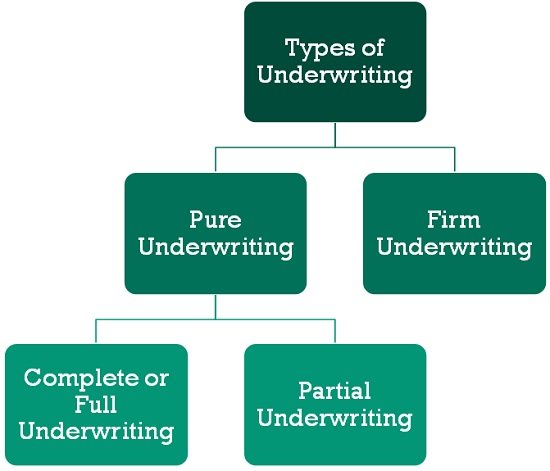
There are two types of underwriting:

Pure Underwriting

Here, the liability of the underwriter is completely contingent. That is he agrees to subscribe for shares which remain unsubscribed by the public. Here, the underwriter agrees to take up the proportion which fails to secure a public subscription. Hence, if shares get full subscription or oversubscription, the underwriter is not liable to take up shares. It can be of two types:

  • Complete or Full Underwriting: When the entire issue of securities is underwritten, it is complete underwriting. Further, the issue is either underwritten by a single underwriter or jointly by several underwriters to cover the risk.
  • Partial Underwriting: The situation when only a part (say 80% or 60%) of the issue of securities is underwritten by one or more underwriters, it is partial underwriting. In this case, the marked applications will be calculated as:
    Marked Applications = Total number of applications received × percentage of underwriting

Firm Underwriting

In this agreement, the liability of the underwriter is half contingent and half definite. There is a definite commitment to accept a certain number of shares regardless of the number of shares subscribed for by the general public. Here, the ascertainment of the underwriter’s liability is in addition to the shares, which are firmly underwritten. In simple words, he has to accept:

  • All the shares the underwriter has committed for ‘firm.’
  • All the shares the underwriter is bound to take as per the agreement.
Enquiry

    error: Content is protected !!