Zero-Based Budgeting (ZBB)

Definition: Zero-based budgeting or ZBB, is an emerging budgeting technique, which is introduced with the aim of coping with the demerits of the traditional budgeting system. Zero-based budgeting is different from the incremental (conventional) budgeting system in the sense that the former begins with a zero base, i.e. from a scratch and are not based on previous trends.

In traditional budgeting, previous year’s figures of expenditure are considered, whereas zero-based budgeting works on the assumption that the budget for the following year is zero till the requirement for a process, project, function, or activity is not confirmed for each penny, right from the first penny incurred.

Simply put, Zero-based budgeting is that form of budgeting wherein each cost element for the period is clearly justified, in terms of cost benefits. The management analyses and prioritizes the activities, depending on the determinants like alignment with the organizational objectives, fund availability, etc.

Hence, all the activities are reassessed every time the budget is prepared. Its aim is to reduce the expenditure, by identifying the areas where cost can be cut.

Characteristics of Zero Based Budgeting

  • Focus of efforts is on both ‘how much’ a unit will incur and ‘why’ it is incurred?
  • Decisions are based on what each unit can offer at the given cost.
  • Individual unit’s objectives are aligned with the corporate objectives.
  • Instant adjustments in the budget are possible if required.
  • All the levels of the organization participate in the process of decision making.

It must be noted that zero-based budgeting technique is purely based on activities, wherein the budget is prepared for every activity, instead of a functional department.

Stages of Zero Based Budgeting

To understand the stages of ZBB, first of all, you need to know the meaning of decision packages. Decision packages refer to the development of an operational plan for the activities for which decisions are to be made. The stages are given as under:

  • Identification and Description of Decision Packages: Decision package ascertains a particular activity, so as to analyse and rank the activities against other activities, with respect to the use of scarce resources and make decisions thereon.
  • Evaluation of Decision Packages: After identification and description, decision packages are evaluated considering the factors like alignment with the organizational objectives, regulatory requirement and availability of money.
  • Prioritisation of the Decision Packages: Decision packages are ranked on the basis of activities.
  • Allocation of Resources: Once the ranking is done, resources are allotted to the packages, which facilitates in the process of preparation of the budget, as it is done for the very first time, without any consideration to previous year’s budgets.

The decision packages provide you with the details such as the cost involved, return, objective, expected outcome, alternatives available and consequences of non-performance of the activity.

Superiority of Zero Based Budgeting over Traditional Budgeting

Zero Based Budgeting uses a scientific technique for evaluating various activities, which certifies that the activities carried out are relevant for the accomplishment of objectives. In addition to this, cost-benefit analysis is performed by the management, before allocating the resources to different activities. Moreover, excessive and unnecessary expenditure on various activities is identified and eliminated.

Lastly, it facilitates the implementation of Management By Objectives (MBO), by involving all the levels of the organization in the process of decision making.

Budgetary Control

Definition: Budgetary control refers to a method of management control and accounting, wherein the budgets are established, by forecasting the activities beforehand to the maximum extent and a constant comparison is made between the actual results and the budgeted figures, so as calculate the variances (if any) and take corrective steps accordingly to ensure the achievement of targets.

Hence we can say that the budget is the cause, and budgetary control is the effect.

Functions of Budgetary Control

  • Setting up of budgets
  • Policymaking
  • Comparing the actual and budgeted results.
  • Taking corrective steps and remedial measures, (if possible) or Revising the budgets (if required).
  • Placing responsibility when there is a failure to attain the target.

Budgetary control implies a system that involves an ongoing comparison of the actual performance with the budgets and taking remedial steps immediately, to ensure adherence to the plan.

Characteristics of Budgetary Control

  • Determination of goals: Budgetary Control helps in ascertaining the goals to be achieved over the accounting period and the policies that are to be implemented for the attainment of these objectives.
  • Attainment of goals: It ascertains the range of activities which are to be carried out for the achievement of objectives.
  • Laying out of plan: It assists in formulating a plan or sketches out the operations, concerning every stage of activity, both physically and monetarily, for the entire period.
  • Making comparison: It establishes a system for comparing the actual performance with the budgeted ones, by every individual, unit or department and ascertains the causes for discrepancies.
  • Correction or Revision: Budgetary control makes sure that the required corrective steps will be taken at the right time when there are deviations from the budgeted targets and if that cannot be implemented then the plan is revised considering all the factors.

Budgetary Control aims at prescribing in exact terms what should be done, how it is to be done in future and ensuring that actual performance is in tandem with the budgets.

Objectives of Budgetary Control

  • To delineate the objectives of the business with precision and establish the performance targets, for every unit and department of business.
  • To define the responsibilities of each supervisor, manager and other personnel, so that every member of the organization knows about his job, rights and duties.
  • To provide a benchmark for making a comparison between standard targets and the actual results, and identify the reasons for so, in order to take necessary actions to correct the divergence.
  • To make optimum utilization of the organization’s resources in order to increase productivity and profitability.
  • To monitor that the firm is not deviated from the path of its long term objectives, without being affected by contingencies.
  • To identify where efforts are required to cope with the situation.
  • To align the activities of the business, centralizing the control, while decentralising the authority and responsibility to executives, in the business interest.
  • To assist in waste elimination, losses during the production and removal of excess costs.
  • To provide a logical basis for the revision of present and future policies.
  • To formulate plans for long term with maximum accuracy.

In a nutshell, Budgetary control analyses how efficiently managers utilize budgets to manage cost and operations in a particular period. It helps the company’s management in delegating the responsibility to the executives and provide a basis for forecasting, so as to measure the variances between actual and estimated results.

Income Statement

Definition: Income Statement or otherwise called as statement of profit and loss, is the summary prepared by the company’s management, reporting the revenues, expenses, gains and losses for the particular financial year. Simply put, it portrays the final result of the company’s operations over a period.

Income statement forms part of the company’s financial statement along with the Balance Sheet, Cash flow Statement and Statement of Owner’s Equity, which is used to analyse the company’s financial position, performance and profitability. It is a report that lists out and categorizes various items of revenues and expenses, that amounts to net profit or loss for the stated period.

Format of Income Statement

Traditionally income statement is called as Profit and Loss Account, which is further subdivided on the basis of the nature of the concern. If the business entity is engaged in production and manufacturing business, there are three main divisions, i.e. manufacturing account, trading account and profit & loss account.

As against, if it is a trading company, then there are only two divisions, i.e. trading account and profit & loss account.

Components of Income Statement

The income statement is a snapshot of how the company’s operating and non-operating activities contribute to the net income or net profit. And so, it includes only nominal accounts. The major components of the income statement are:

  • Operating Revenue: The value received by the enterprise for the goods sold and services rendered to the customers for a particular period less goods and services tax (if any), results in total operating revenue.
  • Operating Expenses: Operating Expenses refers to the expenses which are outrightly related to the entity’s regular business operations so as to provide goods and services to customers, i.e. raw materials, wages and salaries, supplies, rents, etc.
  • Operating Expenses: Operating Expenses refers to the expenses which are outrightly related to the entity’s regular business operations so as to provide goods and services to customers, i.e. raw materials, wages and salaries, supplies, rents, etc.
  • Non-operating Revenue: The amount received from non-core business operations, or from infrequent items are called non-operating revenue, such as dividend income, interest income, commission received etc.
    It includes gains, i.e. the profit from selling old assets, scrap material, ancillary business items or investments, at a value higher than its actual value till date. Here, the word ancillary business items refer to those equipment or objects that help in carrying out business operations.
  • Non-operating Expenses: The amount incurred on non-core business activities or unusual/infrequent items are non-operating expenses, i.e. interest expenses, restructuring expenses, lawsuit settlement expenses, commission paid, etc.
    It covers losses also, i.e. loss on selling the selling old assets, business investments, scrap material, or ancillary business items of the concern at a value lower than its actual value till date, as well as loss from writing down of assets, foreign exchange losses, etc.

Note: Income Statement can be presented in both cash and accrual basis of accounting, however, it should be kept in mind that if there are prepaid expenses and accrued income, income statement reflects higher income in case of accrual basis, but lower in case of cash basis of accounting.

On the other hand, if there is any outstanding expenses or unaccrued income, the income statement shows a lower income in case of accrual basis, but the income will be higher in case of cash basis of accounting.

Basically, income statement acts as a report on the company’s financial health, which is of great use to company’s stakeholders, i.e. business partners, creditors, debtors, investors, suppliers, shareholders and so forth.

Capital Expenditure

Definition: Capital Expenditure or CapEx refers to the financial outlay made by the firm for an asset which is expected to stay in the business for a long time, so as to use the same for more than one financial year, which not only generates enduring benefits for the company but ensures the generation of revenue over the years.

In finer terms, when the company uses its funds for acquiring, improving or upgrading its long term assets, so as to increase its productivity, capacity and efficiency, such an expense is called as capital expenditure.

These expenditures can also be made with the aim of increasing the scope of operations, improving the working condition of assets or extending the useful life of the assets. Such expenditures are primarily made by the company to start a new unit, project or venture, with an aim of earning revenue therefrom.

Examples

  • Overhauling expenses of second-hand machinery.
  • Expenses made by the promoters before the commencement of business, i.e. preliminary expenses are of capital nature.
  • Purchase of assets such as furniture, plant, building, computer, vehicles, etc. for the use in business and not for the purpose of trading and reselling.
  • Trial run expenses of newly installed machinery.
  • Advance paid in relation to a broadband connection, in the office.
  • Fee paid for acquiring a license, to run a specific business.

Capital expenditure incurred by the firm for buying or upgrading the asset accrues long-lasting benefit to the firm and so the total amount spent on it will also be spread over the useful life of the asset.

Furthermore, the asset purchased by making capital expenditure can be reconverted into cash, irrespective of the fact that the reconversion resulted in profit or loss.

Factors Determining Capital Expenditure

There are certain factors on the basis of which the expenses are considered as capital expenditure, they are:

  • Nature: The nature of the business, in which the company trades or deals plays a crucial role here, because, for a company engaged in real estate business, purchase of land or buildings is revenue expenditure, as it is considered as company’s inventory. But for other companies, the purchase of land and building will be a capital expenditure.
  • Frequency: Capital Expenditure involves a one-time outlay of cash, usually nonrecurring in nature, and so it is not directly taken to Profit and Loss account, in the year in which the outlay is done. So, if an expense occurs frequently, it will be considered as an item of revenue expenditure and not a capital one
  • Purpose: Expenditure made by the firm so as to increase the productive capacity of an asset will be regarded as a major repair, and so it is of capital nature.
  • Revenue earning capacity: Any expenditure will be called as capital expenditure if it is made with the purpose of increasing the company’s earning capacity, as well as the benefits of such expenditure extends to a number of years.

Capital Expenditure is shown in the asset section of the balance sheet, as they generate revenue to the company, for more than one accounting year.

Further, these expenses are transferred to the company’s profit and loss account (income statement) of the year, as per the utilization of that benefit, from the expenditure, in the concerned accounting year.

Revenue Expenditure

Definition: Revenue Expenditure, also known as Operating Expenses or OpEx refers to the expenditure incurred in the course of the day-to-day business activities i.e. in the production of goods and services and its sale, which facilitates revenue generation of the company.

Such expenses do not increase the profit earning capacity of the business, rather it helps to maintain the operational ability of the business and also to maintain the assets in their current working condition.

It must be noted that the benefit derived from such expenses do not extend beyond one accounting period, i.e. the company can enjoy the benefits of such expenses for that particular period in which it is incurred. It is not carried forward to future years.

Examples of Revenue Expenditure

  • Salary and Wages
  • Carriage of Goods
  • Rent and rates of factory or office building
  • Interest on borrowed capital
  • Depreciation on fixed assets
  • Cost of Goods Sold
  • Consumable stores
  • Electricity bill
  • Transportation Cost
  • Repairs and Maintenance of Machinery (oiling, cleaning etc.)
  • Raw material, work-in-progress, and finished goods
  • Cost incurred for the upkeep of assets
  • Taxes and Legal Expenses
  • Insurance Premium

Revenue Expenditure appears in the Income Statement (Profit & Loss Account), as it generates benefits to the entity for that particular accounting year, in which it took place. Hence, they are charged to the income statement in the same accounting year

Factors Determining Revenue Expenditure

There are certain factors on the basis of which expenditure is considered as Revenue Expenditure, given as under:

  • Nature of Business: When a company trades in computer systems and its parts, it is considered as inventory for that firm and the cost of buying such inventory is a revenue expenditure. But for the rest of the companies, it is a capital expenditure, as it is going to assist the firm in generating revenue for years.
  • Recurrence: When the expenditure takes place, multiple times in an accounting year, then also the expense is considered as revenue expenditure.
  • Purpose: The revenue expenditures are made on purchasing the inventory for the purpose of resale and not for the purpose of personal use or office use. The expenditure is also incurred to buy raw material to convert the same into finished goods and selling them to customers.
  • Maintenance: If the firm incurs expenses for the normal upkeep of the asset and not to increase its productive capacity, it is regarded as revenue expenditure. Any expenses incurred with the aim of improving its useful life or earning capacity of the asset comes under capital expenditure.
  • Revenue Generation: If the expenses made by the firm helps in the generation of revenue for the current accounting period, it is considered as an operational expense. Furthermore, as per the matching principle, the expense should be matched with the revenue earned during the period, to be regarded as revenue expenditure.
  • Amount Spent: The amount spent as revenue expenditure is comparatively small and the benefit obtained is for a limited period only, i.e. one year or less.

In a nutshell, Revenue expenditure is nothing but the regular cost incurred which assists the firm in smooth running the business i.e. to sustain its business operations. However, it will not add any value to the assets or reduces a liability but it helps to earn revenue for the current period.

The benefits of such expenses can be derived in the same accounting year, as they last for a year only. Further, they are allowed to be deducted for tax purposes in the accounting period in which they are spent, as their incurrence is quite frequent.

Bookkeeping

Definition: Bookkeeping can be defined as the system of keeping records and classifying all the financial transactions on a day-to-day basis concerning the business operations, in a sequential manner.

The term “transaction” refers to the business activity, in which the exchange of money or money’s worth for goods or services is involved.

It is the initial step to the accounting process, which supplies the preliminary information required to prepare and maintain accounts. Hence, the accounting is based on the proper system of bookkeeping. It involves:

  • Gathering basic financial data.
  • Identifying the transactions and events with the financial aspect, i.e. only monetary transactions are to be entered in the books of accounts.
  • Measuring the transactions in monetary terms.
  • Keeping a record of the financial effect of the transactions, in the order in which they arise.
  • Classifying the effect of transactions
  • Preparing statement, i.e. trial balance.

Objectives of Bookkeeping

The main objectives of bookkeeping are:

  • To record the transactions: Bookkeeping is all about keeping a full-fledged record of all the transactions, as and when they take place, in an orderly manner.
  • To ascertain financial effect: Bookkeeping tends to reflect the financial effect of all the business transaction occurred in a financial year on the business.
  • To show the correct position: If bookkeeping work is adequately performed, it shows the correct position of the business, concerning the income and expenditure, assets and liabilities.

The purpose of bookkeeping is to make sure that the financial transaction is correct, chronological, up-to-date and complete. The main aim of maintaining records is to depict the exact position of the company regarding the incomes and expenses.

Types of Bookkeeping System

There are two types of bookkeeping system:

  • Single Entry System: As the name itself signifies, single entry system of bookkeeping involves the recording of only one side of the transaction, as it does not follow any principles or rules. It is mainly used by small businessman, which have minimal transactions.
    This system of bookkeeping is considered as incomplete and inaccurate, as it only maintains a record of cash receipts and payments, purchases and sales.
  • Double Entry System: This system is based on the duality concept, i.e. every transaction affects two accounts. It means that each debit entry to an account has a corresponding credit entry in another account and vice versa.
    This system of bookkeeping is universally adopted and considered as accurate for recording business transactions.

Methods of Bookkeeping

There are two methods of bookkeeping, discussed as under:

  • Manual Bookkeeping: It is the conventional method of bookkeeping which involves manually writing the transactions in the books of accounts. It is mainly used by small businessman having minimum transactions, as it is cheaper and easier to maintain.
  • Computerized Bookkeeping: With the introduction of computers, nowadays all the bookkeeping work is carried out through computers or laptops. It is an emerging method of keeping a record of financial transactions wherein accounting/bookkeeping software packages are used by the businesses.
  • This method of bookkeeping is common among business houses, due to convenience and user-friendly interface.

The task of bookkeeping is performed by a bookkeeper, who keeps track of all the financial data and organizes them systematically.

The work is clerical, which is often delegated to junior employees, in the accounts department. The work involves entering the transactions in the daybooks, i.e. purchase book, purchase return book, sales book, sales return book, cashbook, journal, etc., posting the same to the ledger and finally preparing a trial balance.

Economic Order Quantity (EOQ)

Definition: Economic Order Quantity, popularly known as EOQ is the standard order quantity of materials which a firm should order at a given point in time with an aim of minimizing the annual inventory costs like holding/carrying cost, and order cost.

It is a production scheduling model which was coined by Ford W. Harris in the year 1913 and has been updated with the passage of time.

Ordering Cost

Ordering cost refers to the fixed cost involved in the preparation and processing of the supplier’s order irrespective of the lot size, such as cost of inviting quotations, cost of placing an order, inspection cost, documentation, transportation cost, etc.

Holding Cost

The total cost of holding, i.e. storing and maintaining a specific lot of the inventory, is called holding cost or carrying cost. It embraces warehouse expenses like rent, utilities, salaries, property taxes, etc. opportunity cost, and inventory cost associated with leakage, obsolescence and insurance.

Along with that, the cost of funds invested in inventories is also covered in it.

Formula of EOQ

The formula used for ascertaining the economic order quantity is derived by the renowned mathematician “Wilson”. The formula is given as under:

Where,

  • A = Annual Requirement (demand) for raw material for the year
  • O = Cost of placing per order for purchase
  • C = Cost of carrying average inventory per unit, annually.

EOQ formula is used to decide the optimal order size, i.e. the number of units of products to be added to the inventory with each order at one time.

Why EOQ?

It is a well-known fact that the cost of ordering the inventory decreases with the increase in volume, because of economies of scale, but due to the increase in the size of the inventory, the carrying cost increases.

At EOQ both ordering cost and carrying cost are minimum. It is also called an optimum lot size.

It is mainly used in the field of production, operations, logistics and supply chain management, to ascertain the volume (how much) and frequency (how often) of the orders, needed so as to fulfil the specific level of demand.

EOQ is helpful in determining the ideal order size, so as to maintain a supply chain which is cost-effective. In this, a fixed quantity is ordered whenever the inventory level is down to a certain reorder point. It helps in the calculation of reorder point and reorder quantity, to facilitate immediate refilling of the inventory to avoid shortage.

Assumptions of EOQ

There are certain assumptions with respect to EOQ, which are discussed as under:

  • Material cost per unit, Ordering cost per order and holding cost per unit (on annual basis) is known and fixed.
  • Potential raw materials or inputs usage in units is known.
  • Quantity of material ordered is received instantly, meaning that there is no lead time.
  • The new batch of raw materials is delivered in full
  • The inventory decreases at a fixed rate until it becomes nil.

EOQ calculation determines exactly when an order has to be placed and the quantity which is to be ordered, for uninterrupted production and minimum total cost of inventory.

Contingent Liability

Definition: Contingent Liability refers to an anticipated financial obligation that springs from events that happened in the past and whose existence is validated by the happening or non-happening of the uncertain future event, which is not under the control of the enterprise.

Also, it can be a present financial obligation, whose payment is not likely or whose amount cannot be measured with certainty.

There exists uncertainty as to the timing and extent of the payment, as well as there is possibility of payment not becoming due at all. So, we can say that future events can determine whether it is actually a liability or not. And these are called contingent liability because of the uncertainty attached to it.

Disclosure of contingent liability helps the firm to be prepared for the obligation that may arise at a future date.

These are not actual liabilities of the firm, but a potential one, that may turn out as an actual liability in the future, when the uncertain future event occurs.

Treatment of Contingent Liability

A contingent liability is required to be disclosed but not recognized in the books of accounts of the firm

Though it is an off-balance sheet item, which means that its value does not appear in the amount column at the liabilities side of the balance sheet. Therefore, it is clearly indicated as a footnote in the “Notes to Accounts” except when the possibility of monetary outflow is remote. Contingent liability is accounted for, in the financial statements only if it is expected to occur and its amount can be estimated with reasonable accuracy.

When and Where to Record?

The likelihood of the loss can be divided into – probable, reasonably possible, or remote, as per GAAP:

Probable (More likely than not)

If the probability of the occurrence of the event is greater than the probability of its non-occurrence, the event will be considered probable. So these liabilities are expected to occur and so the amount of loss can also be determined to a certain extent. Hence, they appear as liabilities in the financial statements.

Reasonably Possible (Less than likely)

The term ‘reasonably possible’ means that the possibility of the occurrence of the event is greater than remote but less than probable. As the amount cannot be evaluated with certainty, these appear in the form of notes.

Such liabilities are evaluated at frequent intervals, so as to ascertain whether the monetary outflow representing economic benefits is probable. Hence, when it comes out to be probable with regard to the monetary outflow will be needed for an item that is earlier treated as a contingent liability, a provision is made in the financial statement of the concerned period, in which the change in probability took place, except when the reliable estimate cannot be made.

Further, the estimation helps in setting aside the amount to be paid, when the liability occurs.

Remote

An event whose possibility of future settlement is quite small, is regarded as remote. Companies do not record such liabilities.

Types of Contingent Liability

There are two types of contingent liability:

1. Explicit Contingent Liabilities: Contingent Liabilities rely on contract, law, or direct policy commitments of the government with regard to payment when a specific event occurs. These are either determined by law or authorized by law. So, it covers:

  • Loan guarantee
  • Export Guarantee
  • Other financial guarantees like exchange rate guarantee, minimum pension guarantee, deposit guarantee, etc.
  • Government insurance program
  • Legal claims against the government
  • Indemnities
  • Uncalled capital

2. Implicit Contingent Liabilities: The financial obligation of these liabilities should be recognized after the event, i.e. when the crisis or disaster occurs. Also, the official recording of these contingent liabilities is not made by the government due to its uncertainty. It may include:

  • Natural disaster relief
  • Banking system bailouts
  • Environmental cleanup spending
  • Municipality defaults

Examples of Contingent Liability

  • Liquidated Damages
  • Product Warranty
  • Long pending lawsuit
  • Government investigation
  • Guarantee given by Surety
  • Value of bills discounted
  • Claims against firm not recognized as debts

Subsidiary Book

Definition: Subsidiary books are special-purpose accounting books that record transactions belonging to the same category in a particular book in a sequential manner. Also, the transactions are recorded in their original form, i.e. as and when the transactions occur, they are entered in the subsidiary book before posting them anywhere that is why they are also known as the book of original entry.

Basically, Journal is a book in which primary entries are made as and when they take place. However practically there is an end number of transactions that take place on a day-to-day basis, so it is not easy to record all the transactions in one place, i.e. journal, as it will become unnecessarily bulky and increase the occurrence of errors. For this purpose, the journal is sub-divided into special journals, which we call subsidiary books.

Types of Subsidiary Books

There are four types of subsidiary books:

Day Books

Purchase Day Book

This book is used to keep a record of all credit purchases of the goods made by the firm during the course of the accounting period. For this purpose, Purchase invoices act as a base for recording transactions in the purchase book.

However, credit purchases of the fixed assets are entered in the journal proper. It indicates the name of the parties from whom goods are bought on credit. So, these parties are creditors of the firm. And, creditors’ accounts will be credited with the amount, in the purchases book.

Further, the total of the purchase book will be posted to the debit of the Purchase Account, at the end of the month.

Sales Day Book

This book keeps a track of all the credit sales of goods made by the firm during the course of the accounting period. Sales invoices form the base for recording sales transactions. It is worth noting that credit sales of assets are entered in the Journal Proper. It shows the name of those customers to whom the goods are sold on credit, which are technically the debtors of the firm. Further, the account of the debtors needs to be debited with the respective amount.

The total appearing in the sales book reflects the credit sales that took place during the period. So this amount is taken to the credit of the Sales ledger at the end of the month.

Purchase Return Book

Otherwise called a return outward book, it keeps a record of the returns of the goods made to the suppliers by the firm. On returning the goods to the supplier, the debit note is issued by the firm (debtor or buyer) to the supplier (creditor or seller). The debit note acts as a base for recording transactions in the purchase return book.

For this purpose, debit is made to the creditor’s account with the respective amount. And the total amount of this book is transferred to the credit of the purchase return ledger. It is to be kept in mind that the return of cash purchases should be entered in the cash book.

Sales Return Book

Also known as the return inward book, this book maintains a record of goods returned by the customers which are sold by the firm. When the customer return goods to the firm, a credit note is issued to the customer (buyer or debtor) by the firm (creditor or seller). These notes act as a basis for recording the transaction in the sales return book.

So, the debtor’s account is credited with the respective amount as return inward and the total amount of the goods returned is posted to the debit of the sales return account. It is worth noting that the return of the sales made in cash is entered in the cash book.

Bill Books

Bills Receivable Book

When the firm draws bills in favor of its customers then the book maintained to keep a record of such bills is called bills receivable book. The amount will be posted at the credit side of the individual party’s account as bills receivable. The total of bills receivable book will be taken to the debit side of the bills receivable account at the end of the month.

Here it should be noted that the transactions associated with bills dishonor, endorsement, etc are not entered in this book, as they are entered in Journal.

Bills Payable Book

Bills payable book keeps a record of all the bills accepted by the firm drawn by the suppliers for the purpose of the payment at a future date. The amount will be posted on the debit side of the individual party’s account. Further, the total of these books is credited to the bills payable ledger account at the end of the month.

Cash Books

All the transactions, related to receipts and payments related to cash sales, cash purchases, sale of assets in cash, payment of expenses in cash, receipt of income in cash, etc which are either made by cash or cheque are recorded in the cash book.

Petty Cash Book

This book records all the day-to-day petty expenses whose payment is made in cash.

Journal Proper

In case no special book exists for recording a transaction, these are entered in the journal proper. In general, journal proper contains entries such as opening entries, closing entries, rectification entries, transfer entries, adjustment entries, entries for bills dishonor, miscellaneous entries, etc.

Advantages of Subsidiary Books

  • Automatic classification of transaction: As a separate book exists for every category of the transaction, so the transactions belonging to a specific category are recorded in one place.
  • Easy for Reference: As different books are maintained for different types of transactions, the reference becomes very easy as one can refer to the concerned subsidiary book, which reduces the wastage of time in finding the entries.
  • Facilitates division of work: As the journal is divided into multiple subsidiary books, the work of recording the transactions is divided among different employees, which helps in the instant recording of transactions. And so the responsibility of maintaining the book can be entrusted to an employee who will keep it up to date.
  • Identification of Error: In case the Trial Balance does not tally, the errors can be easily located and rectified.
  • Internal Check system: As the recording of different transactions is done by different employees, the work is divided in a manner in which it the work performed by one person is automatically checked by another person. In this way, it enables internal checks and prevents the occurrence of errors and frauds.
  • Ease in transfer: When the entries are made in separate books, they can be easily transferred to their concerned ledger account.
  • Classification of transaction: Transactions can be easily classified into cash transactions and credit transactions.

Wrap Up

Therefore, depending on the requirements of the concern, the journal book is classified into various types and the transactions are recorded in these special journals based on the nature of the transaction. In this way, the occurrence of error is minimum and saves a lot of time.

Source Document

Definition: Source Document is the root document that bears the essential information related to the business transaction. When a business transaction takes place, a piece of written, printed, typed or electronic trail is generated which stores data relating to the transaction and acts as a formal or official record. This document is the source document.

Basically, these documents substantiate the business transaction, whose entry is made in the books, as they are the first and foremost input to the accounting process.

Additionally, these documents carry a unique number, either numeric or alphanumeric, which not just helps in identification, but also facilitates referencing. And because these are pre-numbered, they help in the classification of transactions and also find out the missing source documents.

This documentary evidence contains the nature of the transaction, the name, and address of parties, date and amount of transaction, etc.

After recording the information provided by the source document, they are indexed and retained properly, to access them whenever required. In addition, the auditor can also review them at the time of auditing the company’s financial statement, to check whether the transactions have occurred in reality.

Example

Think of a situation when we sell goods to customers, we prepare invoices for sending goods, bills receivable in case of credit sales, and cash memos in case of cash sales. The original is delivered to the customer, and the duplicate is retained as a record in the business. Such a duplicate copy is the source document.

Here, we are going to talk about some commonly used Source Documents:

Cash memo

On purchasing goods in cash from a trader, the seller (trader) provides a cash memo to the buyer, as a receipt of purchase. It comprises the details of goods sold, i.e. name of selling organization, name of the purchaser, quantity, and price of the units purchased, date, and amount of the transaction, etc.

Specimen of Cash Memo

Invoice

On the sale of goods on credit, the seller of the goods prepares a sales invoice. It is prepared in three copies, the first one is delivered to the buyer, the second one is kept in the bundle of goods, the third copy is retained by the seller for future reference. It contains the details like the name of the purchaser, description of goods sold, i.e. quantity and price of the units sold, total amount, and tax.

Specimen of Invoice

Receipt

When a certain amount is received from a customer, a document is issued as a receipt that shows the date and amount of payment, details of the payer, and purpose of payment. The counterfoil or carbon copy of such receipt is used as a source document.

Specimen of Receipt

Debit note

When the buyer of the goods returns them to the supplier, due to reasons like a defect, inferior quality, or substandard product. In such a case a note is given to the supplier along with the goods returned, which indicates that there is a debit in their account for goods given back to the supplier, which is called a debit note. It bears the date of return, quantity and amount, name of the supplier, and the reason for returning goods.

Specimen of Debit Note

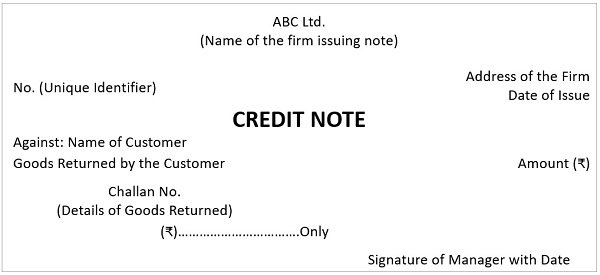
Credit note

On receiving the goods returned by the customers for being defective or inferior in quality, along with a debit note, another note is issued by the seller to the purchaser, which indicates the acceptance of the claim raised by the purchaser, which is known as a credit note.

By issuing a credit note to the customer, the seller gives his affirmation regarding the acceptance of the goods as well as certifies that due credit will be provided for the goods returned.

Specimen of Credit Note

Cheque

Cheques are issued by the account holders for making different payments. the counterfoils or notes on the cheque book carry details regarding the payment made. It can be used for the purpose of recording transactions. these are deposited together with the pay-in-slip, which can be used as a source document.

Specimen of Cheque

Pay-in slip

A form is provided by the bank to its customers or account holders at the time of depositing the cash or cheque at the bank.

It is divided into two parts. The part on the left is used as a counterfoil, whereas the right part is for use by the banker. Both the parts are stamped and signed by the cashier when cash or cheque is deposited and the counterfoil is returned to the customer. It contains the details of cash or cheque deposited, name of the bank branch, account number, name of the account holder, the signature of the depositor, cheque number, etc.

Specimen of Pay-in Slip

Apart from the documents given above, there are other documents also which serve as evidence for recording transactions like the point of sales summary, salary slip, bank statements, utility bills, etc.

Must Note
Transactions can be recorded in the books, only on the basis of documentary evidence. Therefore, in the absence of such documents, no transaction will be entered into the books.
These documents are needed at the time of audit and tax assessment.
These act as legal proof in case of dispute between parties.

Enquiry

    error: Content is protected !!